
Today we will look at a few options for truly wireless headphones that I believe you should consider.
Author: krishnavamshi24
Cosmos DB – Introduction
What is NO SQL?
- It is term coined to address databases that used to query non structured data using a different Query Language. In the case of Cosmos we use a special style of SQL Queries on Cosmos DB.
What is the need for NoSQL?
- Volume of Data, Velocity at which it was needed to be gathered besides Variety of data needed to be stored changed dramatically thanks to the internet .
- Traditional systems handle data which are having fixed schema, planned capacity both in terms of throughput and Size.
- When the data volumes were high the attempt was to scale up higher by adding more memory, more CPU and more disk space. But this in turn compromised on latency besides being very expensive and difficult to maintain.
- Traditional systems tried to resolve this problem by introducing Manual Sharding
using Custom Application code to distribute the table data across different nodes and adding Distributed Cache to help the reads. But still the fixed schema meant down time besides additional effort on both in Application code front and Database code. Thus enters the need for No SQL where automatic sharding, implicit schema binding and high throughput and latency are available from the start.
What is Cosmos DB?
Azure Cosmos DB is a globally distributed, multi-model database service that supports document, key-value, wide-column, and graph databases. Originally Microsoft offered in only API which is SQL API.
What are the key features of COSMOS DB/
- Elastically and independently scale throughput and storage across any number of Azure regions worldwide
- Use your favorite API including SQL, MongoDB, Cassandra, Tables, or Gremlin.
- Always On – 99.999% high availability
- Guaranteed Low Latency at 99th Percentile.
- Defined Consistency Levels
- No Schema or Index Management
- Encrypted at Rest and Motion
References:
https://docs.microsoft.com/en-us/azure/cosmos-db/introduction
Hierarchial Data – SQL Server
- From Which Edition is it Available
- SQL Server 2008
- What is HierarchyId?
- It is a datatype introduced in SQL Server to be used for identifying the parent / child relationships
- It is helpful in querying hierarchical data
- Examples of Hierarchial data include an Folder structure (root folder, sub folder, Items)
- Key Properties of HierarchyId
- It is variable length system datatype, the size depends on the number of children elements within the tree. i.e. for small trees that contain say 0-7 the size as mentioned in microsoft website is about 6*logAn bits, where A is the average number of children in the tree.
- Comparison is in depth order i.e. Level1
- Support for insertions and deletions i.e. GetDescendantMethod.
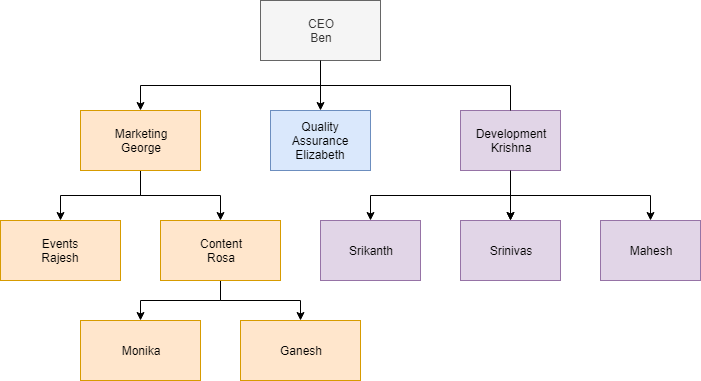
Looking at the organization chart above, the SQL table similar to this would look something like below. please take a look at examples given below at Microsoft Website
Key Methods available as part of hiearchyId are listed below.
Indexing strategies for Hierarchial data are based on two approaches 1) Breadth-first and Depth First.
Useful links:
The Journey Begins
Thanks for joining me!
Good company in a journey makes the way seem shorter. — Izaak Walton


